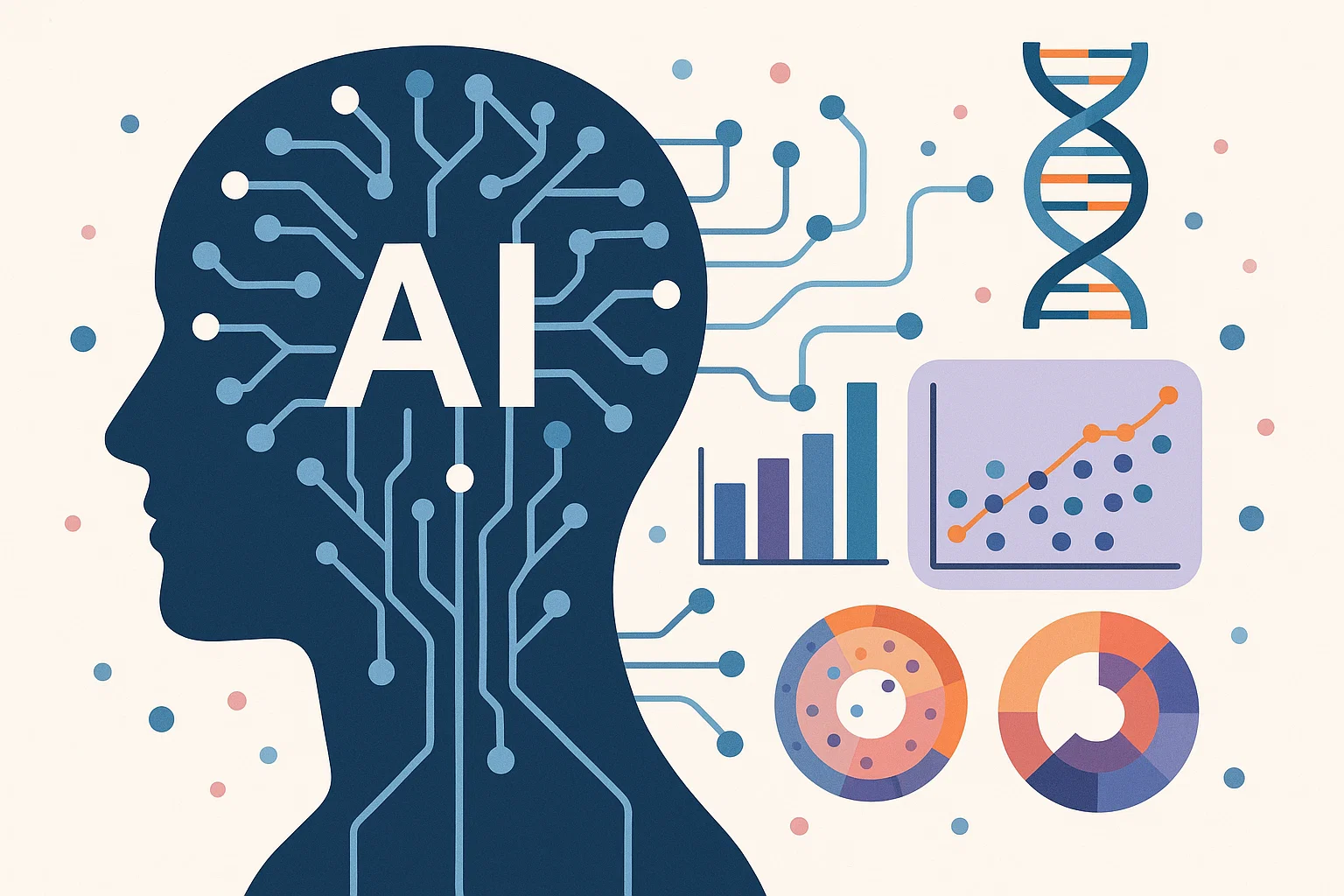
AI biomarkers have become the most important part of predictive, preventative, and personalized therapy as healthcare changes. AI biomarkers are different from traditional biomarkers since they use large datasets, machine learning models, and computational insights to find complicated disease signs. Traditional biomarkers only look at biological qualities that can be seen. These digital biomarkers find connections between genes, proteins, and environmental factors that humans can’t see.
Key contributions of AI Biomarkers include:
- Finding chronic and rare diseases early on
- Keeping an eye on patients all the time using digital health data
- Making medication research and validation better
- Making clinical trials more accurate and successful
AI biomarkers are changing not only how we diagnose diseases but also how doctors think about and care for people’s health. Nexomic is at the forefront of integrating these advancements into real-world healthcare solutions.
What AI Multi-Omics Is Doing to Change Our Understanding of Biology
AI multi-omics is a new way of doing things that combines artificial intelligence with multi-omics. This method brings together several omic layers, such as genomics, transcriptomics, proteomics, metabolomics, and others, into one analytical framework. In the past, these datasets were looked at one at a time, which made it hard to get a full picture. But with AI multi-omics, scientists can now understand how different biological systems work together in ways that have never been possible before.
AI systems analyze multi-dimensional omic data to identify correlations elucidating the impact of genetic variants on health outcomes. This makes it possible to create precision medicines that are specific to a person’s biology.
Some benefits of AI multi-omics are:
- Easy integration of many types of organic facts
- A higher knowledge of ways illnesses works
- Finding multi-factorial illness pathways
- A higher technique to forecast how properly remedies will paintings
AI multi-omics gives us a complete picture of biology by linking molecular data with clinical reality in real time. Nexomic’s innovative approach in AI multi-omics enables seamless data interpretation and meaningful healthcare outcomes.
The Connection Between AI Biomarkers and AI Multi-Omics
AI biomarkers and AI multi-omics are both game-changers on their own, but together they really define the future era of precision medicine. AI biomarkers use multi-omic data to make predictions, and multi-omics benefits from AI’s capacity to figure out how different biological systems interact with each other. Together, they make a living ecosystem where the biological data of each patient is transformed into useful information.
This convergence gives doctors the ability to tailor care with unmatched precision. For example, combining AI multi-omics data can help create new AI biomarkers that can tell how well a treatment will work or how quickly a disease will get worse. The outcome is a smart healthcare system that can change based on each person’s unique biological and environmental profile.
This relationship makes it possible to:
- Use smarter diagnostic technologies
- Use predictive modeling to figure out how patients will respond to treatment
- Use real-time patient data to make decisions
- Better accuracy in making healthcare decisions
The combination of these two strong technologies shows that the future of medicine is not just in gathering data, but also in making sense of it and turning it into useful information. Nexomic exemplifies this integration by developing tools that translate complex data into actionable insights.
Data-Driven Intelligence: The Road to Personalized Medicine
The fundamental principle of this scientific advancement is the conviction that medicine ought to be as distinctive as the individuals it helps. AI biomarkers and AI multi-omics are changing the way healthcare works from reactive to proactive. Doctors may now anticipate possible health problems coming, keep an eye on developments in real time, and give medicines that are right for a patient’s genes and molecules.
The effects of this change are:
- Fewer mistakes in diagnosis
- Customized preventative plans
- Treatment that works best in real time
- Affordable, scalable healthcare options.
Conclusion
The combination of AI Biomarkers and AI multi-omics is a big step toward completely individualized treatment as medicine moves into a data-driven age. This change is more than just a step forward in technology; it changes how we think about existence itself. Visit nexomic.com to learn more about this cutting-edge area of precision medicine. There, you can witness how Nexomic-powered healthcare is already taking shape.